Listen
Episode Description
Rebecca St. James was 18 when she recorded "God," the title track of the 1996 album that became her breakthrough. It did not sound like the CCM around it. The vocals are bone dry, the drums drive the whole record, and the intro is built on Irish flute and didgeridoo before the rock kicks in. This episode digs into how that record got made, who played on it, and what 1996 actually looked and sounded like, from Tickle Me Elmo and a blockbuster summer at the movies to the Macarena, the Unabomber arrest, and AOL going flat-rate and falling over. Third Chair guest Kalli Franz has never heard the song or seen the music video, and she watches both for the first time on camera. Also in this episode: a key change nobody saw coming, three very different ideas for how to remake the song today, and a game called Savior or Sweetheart that does not go well for one of the hosts.
Opening Banter
Second episode of CCM Soundcheck, and the format gets laid out again for anyone starting here. Two longtime friends who grew up on Christian contemporary music, plus a rotating Third Chair guest who has never heard the song being discussed. This episode's guest is Kalli Franz, a worship leader at the same church the hosts attend. A coincidence surfaces before the episode even gets going: Kalli was born in 1996, the same year "God" was released, in September, about three months after the album came out. That fact gets mined for the rest of the episode. The song on the table is Rebecca St. James singing "God," released in 1996.
That Reminds Me
Two very different first encounters with this song. One is a high school memory of hearing it around freshman or sophomore year and thinking it rocked, back when most Christian music sounded heavily produced and studio-centric. This one was raw, the vocals super dry, quintessentially nineties. That leads into a longer memory of hearing Alanis Morissette's Jagged Little Pill played on repeat over the loudspeakers at a public pool next to the tennis courts where he and his dad played, and being captured by that sound before ever connecting it to this record. Listening back with a producer's ear years later, the production similarities are obvious.
The other memory is less flattering and funnier. A 17-year-old brother was obsessed with Rebecca St. James, played this song constantly, and the reflex was to decide that if he liked her, nobody else in the house had to. There was also a competing obsession at the time with the big nuanced vocalists of the era, Whitney Houston after The Bodyguard and Mariah Carey, which is a very different lane from what Rebecca St. James was doing. Relistening in preparation for this episode brought all of it back, including one vocal lick in the chorus that never left.
Liner Notes
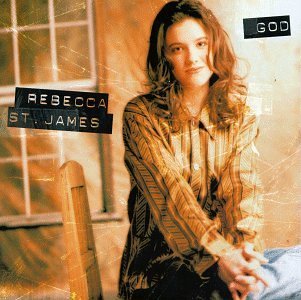
"God" is the title track of Rebecca St. James's 1996 album God, dated June 25, 1996 by Apple Music. She co-wrote it with Tedd Tjornhom, credited as Tedd T., who also produced the record and played a large share of the instruments on it.
The album performed well. It peaked at No. 6 on Billboard's Christian Albums chart, reached No. 10 on the Heatseekers chart, and gave St. James her first appearance on the Billboard 200. It picked up a 1997 Grammy nomination for Best Rock Gospel Album. She was 18 when it came out, one month short of her 19th birthday.
Tedd T. turns out to be the thread worth pulling. He went on to produce for Stacie Orrico, Mutemath's early records, TobyMac, Newsboys, and Delirious?, including their album Glo. He is also credited across multiple for KING & COUNTRY albums, which is a better story than it looks on paper: the brothers in for KING & COUNTRY are Rebecca St. James's younger brothers. The producer who made her breakthrough record went on to make theirs.
The player credits are the other highlight. Rebecca St. James on vocals, Dan Needham on drums and percussion, Brent Milligan on bass, Vince Emmett on electric and steel guitar, David Cleveland on acoustic guitar, Tedd T. on Fender Rhodes, piano, bass, harmonica, percussion and programming, Carl Marsh on mellotron, accordion and string arrangements, and Hunter Lee on Irish flute, uilleann pipes and didgeridoo. Yes, those last three are audible in the song. There is also a personal connection at the table: a church acquaintance went to college with Dan Needham, which came to light through drum lessons.
Four months after release, "God" landed as track 15 on WOW 1997, the year's flagship 30-track CCM compilation, which went to No. 1 on Billboard's Top Contemporary Christian chart and was certified platinum. For a lot of listeners, that compilation was where they met the song, not the album.
Two things came up on air that the research did not confirm. One was that Eddie DeGarmo served as executive producer on the album. The other was that the record was tracked in Nashville. Both were flagged as unverified in the moment and are repeated here the same way.
Note on album credits from the era: they often list musicians for the whole album rather than track by track, so some assignments are approximations.
Sources:
- Apple Music, God (album): https://music.apple.com/us/album/god/724015444
- Discogs, ForeFront CD release r1988060: https://www.discogs.com/release/1988060-Rebecca-St-James-God
- Wikipedia, Rebecca St. James discography: https://en.wikipedia.org/wiki/Rebecca_St._James_discography
- Recording Academy: https://www.grammy.com/artists/rebecca-st-james/6238/
- Wikipedia, God (Rebecca St. James album): https://en.wikipedia.org/wiki/God_(Rebecca_St._James_album)
- Wikipedia, Tedd T.: https://en.wikipedia.org/wiki/Tedd_T.
- Wikipedia, WOW 1997: https://en.wikipedia.org/wiki/WOW_1997
History Lesson
What the world looked like in 1996, while this song was at its peak.
Tickle Me Elmo was the holiday toy frenzy of the year. At least a million sold, and stores cleared stock nearly as fast as it arrived. The table put it in a line that runs through Cabbage Patch dolls in the eighties and Black Friday television stampedes later, with a running suspicion that the annual "this is the one you won't be able to find" news segment is partly manufactured demand.
The summer of 1996 was a blockbuster summer. Independence Day was the No. 1 domestic film of the year at $306,156,090. Twister ranked second at $241,721,524, opening May 10. Mission: Impossible ranked third at $180,981,856, opening May 22. All three came up as personal favorites, along with a Tornado Alley childhood that made Twister required viewing and a memory of catching the original Mission: Impossible series on reruns.
On secular radio, "Macarena" by Los del Rio, in the Bayside Boys Mix, was Billboard's year-end No. 1 Hot 100 single and spent 14 straight weeks at No. 1 from August 3 to November 2. "One Sweet Day" by Mariah Carey and Boyz II Men ranked No. 2, a late 1995 release whose 16-week run at No. 1 carried into March 1996. "Because You Loved Me" by Celine Dion ranked No. 3, the theme from Up Close and Personal. Alanis Morissette's Jagged Little Pill was the No. 1 album on the year-end Billboard 200, which is worth sitting with: no single from it topped the year, but the album outsold everything.
Two news stories dominated. A bomb in Atlanta's Centennial Olympic Park on July 27, 1996 killed one woman and injured 111 people during the Summer Games. The conversation wandered into the 2019 film about Richard Jewell, the security guard wrongly suspected in the immediate aftermath, and nobody at the table could recall how the case finally resolved. It was Eric Rudolph, who was not identified until years later. Separately, Theodore Kaczynski was arrested on April 3, 1996, ending the Unabomber search. His mail bombs killed three people and injured or maimed 23 others, and investigators had been looking for him since 1978.
In church culture, the 27th Dove Awards on April 25, 1996 named dc Talk Artist of the Year, the first group to take the top prize since the Imperials in 1981. dc Talk also won Song of the Year and Rock Recorded Song of the Year for "Jesus Freak." The same ceremony named Jars of Clay New Artist of the Year, Point of Grace Group of the Year, Gary Chapman Male Vocalist of the Year, and CeCe Winans Female Vocalist of the Year. The dc Talk result lands harder after Episode 001: five years earlier they were guests on Carman's "Addicted to Jesus." The Addicted to Jesus tour jacket was in the studio for this recording.
The last item was AOL. In December 1996 AOL moved users to flat-rate unlimited access at $19.95 a month, demand overwhelmed the network, and subscribers ran into constant busy signals. The press nicknamed it America On Hold. That prompted a full account of installing a second phone line, paid for with part-time job money, so a pastor's home phone could stay free, and then downloading a program that ran multiple dialers at once hoping one would connect.
Sources:
- National Museum of Toys and Miniatures, Neato Toys of the Nineties: https://toyandminiaturemuseum.org/neato-toys-nineties/
- Box Office Mojo, Domestic Box Office For 1996: https://www.boxofficemojo.com/year/1996/
- Wikipedia, Billboard Year-End Hot 100 singles of 1996: https://en.wikipedia.org/wiki/Billboard_Year-End_Hot_100_singles_of_1996
- BestSellingAlbums.org, Billboard Top Albums 1996: https://bestsellingalbums.org/year-end/Billboard_Top_Albums_1996
- FBI, Eric Rudolph case file: https://www.fbi.gov/history/cases-and-criminals/eric-rudolph
- Associated Press year-end review, carried by the Deseret News: https://www.deseret.com/1997/1/2/19287022/top-stories-of-1996/
- Associated Press Dove Awards report, Roanoke Times archive at Virginia Tech: https://scholar.lib.vt.edu/VA-news/ROA-Times/issues/1996/rt9604/960427/04300013.htm
- Associated Press Dove Awards winners list, Roanoke Times archive at Virginia Tech: https://scholar.lib.vt.edu/VA-news/ROA-Times/issues/1996/rt9604/960427/04300012.htm
- Washington State Attorney General, AOL agreement: https://www.atg.wa.gov/news/news-releases/ag-reaches-agreement-america-online
Cold Reaction
Kalli had never heard "God" and had never seen the video. Both played for the first time here, paused throughout.
The opening lands before anyone expects it. The Irish flute comes in and the room immediately reaches for comparisons: a karate dojo, a wellness spa, something in the world music lane that was everywhere in the nineties alongside Enya and Yanni. Then the drums arrive and the spa vibe is gone.
The vocal drew the first real discussion. Not so much an Australian accent as a heavy emphasis on elongated vowels and a repeated slide. That put the room on the Alanis Morissette comparison for good, both in the singing and in the visual presentation, all hair in the face and emphatic head movements. One read was musical theater, a resemblance to Lea Michele, especially in the chorus. Another was that it is the diametric opposite of the Sandy Patti and CeCe Winans school of controlled placement and diaphragm support, and that is exactly what makes it sound authentic rather than polished. This was before Auto-Tune was standard, and probably still tape, so those are real takes.
The video was a puzzle from start to finish. A shirtless man appears, then hangs from a rope, then falls, then stands in front of barbed wire. A key flies through space and she is holding it at the end. There is a flare or an explosion over the Earth. Her white outfit with a sash reads as Messianic, or possibly Hindu, or possibly nothing in particular. The consensus was that the director arrived with a concept already in hand and applied it to whatever song came along. The comparison was made to Episode 001's "Addicted to Jesus" video and to nineties Christian music videos generally, which tended to be either a stage performance or a string of visual non sequiturs. Everyone agreed to separate the song from the video.
The production talk was the strongest part. The drums are noticeably dry in the verses and completely change character in the chorus. The vocals are layered and doubled with no reverb, right in your face. And then there is the key change, which nobody at the table remembered: the bridge drops the key rather than raising it, strips instrumentation, sits in something more menacing and introspective for a couple of measures, and then climbs back to the original key for the final chorus. Someone got goosebumps. There was an open question about whether it was played that way or achieved by pitching the tape in post, and a genuine invitation for anyone who knows to say so in the comments.
One recollection surfaced that the song was originally envisioned as something softer and more tender, and that the producer pushed to rock it up instead, possibly out of a prayer between the two of them. It was flagged on air as unconfirmed, and it is repeated here on the same terms. Kalli's reaction was that it would explain a lot, since the verses read like they belong in a slower song.
Three words each, at the end. Raw, disjointed, catchy. Nostalgic, pleasantly surprised, catchy. Authentic, earworm, appreciation.
Audience question: Rebecca St. James was 18 when she recorded this. Who was the artist who felt like they were speaking straight to you at that age, and do they still hold up?
Re-Produced
Three different remakes, three different directions.
The first pick was Sara Groves, turning it into something contemplative and intimate. Slow it down, pull the drums back, build it on real instruments and a real piano, and adjust the hook of the chorus so it is less of a pop-up, with the acknowledged risk that you lose the hook entirely doing that.
The second pick was for KING & COUNTRY, her own brothers, which somehow had not occurred to anyone before it was said out loud. Their whole sound leans on big percussive arrangements, and this chorus already sits between a rock beat and a tribal one, so it is nearly a direct fit. Modern production, possibly with Rebecca St. James herself guesting as a tribute. Keep the key change. Lose the flute and the world music intro entirely and replace it with something synth driven.
The third pick split the difference: an indie treatment, keeping the energy but pulling back the rock, with Aodhan King of Hillsong Young & Free on vocals for the higher, thinner timbre, and some of The Strokes' grunginess in the production.
Game
The game is Savior or Sweetheart. Four short lyric excerpts are read aloud with all titles and artists hidden. Three are CCM songs, one is secular, and the guessers have to find the sweetheart hiding among the saviors. Five rounds, guesses collected independently with no conferring, and the answer revealed before moving on. Every song is drawn from the show's 1985 to 2005 window.
Answers below. Stop reading here if you want to play along first.
Round 1: Rebecca St. James, "You Then Me" (God, 1996). Avalon, "Can't Live a Day" (In a Different Light, 1999). Newsboys, "Entertaining Angels" (Step Up to the Microphone, 1998). Richard Marx, "Right Here Waiting" (Repeat Offender, 1989), the secular one. Nobody got it.
Round 2: MercyMe, "Here With Me" (Undone, 2004). LeAnn Rimes, "How Do I Live" (You Light Up My Life, 1997), the secular one. Delirious?, "Deeper" (King of Fools, 1997). Plus One, "Written On My Heart" (The Promise, 2000).
Round 3: The Pretenders, "I'll Stand By You" (Last of the Independents, 1994), the secular one. Rachael Lampa, "Live For You" (Live For You, 2000). BarlowGirl, "Never Alone" (BarlowGirl, 2004). White Heart, "Desert Rose" (Powerhouse, 1990). Nobody got it.
Round 4: Rebecca St. James, "Reborn" (Transform, 2000). Michael W. Smith, "I Will Be Here For You" (Change Your World, 1992). Savage Garden, "Truly Madly Deeply" (Savage Garden, 1997), the secular one. dc Talk, "Between You and Me" (Jesus Freak, 1996).
Round 5: Geoff Moore and the Distance, "Listen to Our Hearts" (A Friend Like U, 1992). Third Day, "Love Song" (Third Day, 1996). Delirious?, "Obsession" (Cutting Edge, 1995). U2, "All I Want Is You" (Rattle and Hum, 1988), the secular one.
Final score: Kalli 3, Gary 1.
Wrap-Up
Answers from Episode 001's audience question got read first. That question asked which two artists from completely different genres you would put together on a collaboration, prompted by Carman and dc Talk teaming up on "Addicted to Jesus" in 1991. The answers included Petra with the Gaither Homecoming crew, which came in twice from different people, one of them a host's father by text rather than by comment. Also Sandy Patti with Darrell Evans, Steve Green with White Heart, and Stryper with Bryan Duncan, which got the strongest reaction at the table and an immediate side quest about doing a full Bryan Duncan episode.
This episode's question goes back to the comments: Rebecca St. James was 18 when she recorded this. Who was the artist who felt like they were speaking straight to you at that age, and do they still hold up? Leave it on YouTube, Facebook, or wherever you find the show, because all of it gets read.
The standing ask closes it out. If there is a CCM song you want covered on a future episode, drop it in the comments. Picking the next song is genuinely the hardest part, and every episode generates five more ideas than it resolves.
That's a wrap on the soundcheck.